ECM Synchronika vs ECM Classika PID
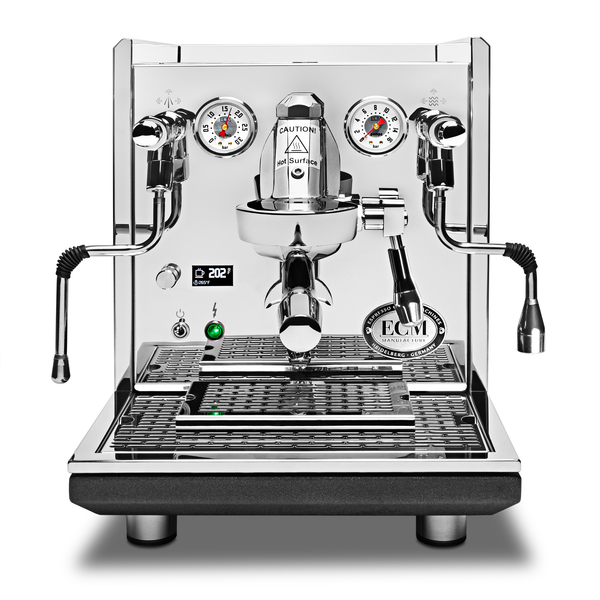

Quick take: The ECM Classika PID costs $1,900 less; the ECM Synchronika heats up faster (6.5 minutes).
| Spec | ECM Synchronika | ECM Classika PID |
|---|---|---|
| Standout features | Steam Wand, Dual Boiler, PID Control, Pre-Infusion, Flow Control Paddle | PID with Shot Timer, Fast Heat-Up Cycle, 0.75L Stainless Boiler, 58mm Portafilter, Made in Germany |
| Approx. price | ~$3,599 | ~$1,699 |
| Type | Semi-Automatic | Semi-Automatic |
| Boiler | Dual Boiler | Single Boiler |
| Built-in grinder | No | No |
| Pump pressure | 9 bar | 9 bar |
| Water capacity | 100 oz | 95 oz |
| Warm-up time | 6.5 minutes | 10 minutes |
| Steam wand | Manual | Commercial Manual |
| Basket type | Unpressurized | Unpressurized Only |
| Best for | Enthusiasts | Enthusiasts |
| Dimensions | 13.2 x 19.3 x 16.1 in | 9.8 x 17.5 x 15.6 in |
| Weight | 66 lbs | 41 lbs |
| Warranty | 3 years | 3 years |
Pros & cons
ECM Synchronika
- ✓Exceptional build quality
- ✓Dual PID with shot timer
- ✓Plumbable or tank
- ✓Quiet operation
- ✓Holds value extremely well
- ✗Very expensive
- ✗Heavy footprint
- ✗Flow control sold separately
- ✗Massive 19-inch-deep footprint
ECM Classika PID
- ✓Full E61 group with PID and shot timer at a single-boiler price
- ✓Fast Heat Up cycle cuts E61 warm-up to about 10 minutes
- ✓Immaculate German fit and finish - polished stainless throughout
- ✓Stainless steel boiler resists scale and corrosion
- ✗Cannot brew and steam at the same time
- ✗Boiler needs a cooling flush after steaming
- ✗Flow control adds $100 to the price
- ✗Small drip tray fills quickly with E61 flushes
What owners say
ECM Synchronika
The Synchronika is the machine people describe as heirloom-grade, and they mean it fairly literally — a German-built E61 dual boiler with the kind of construction that owners expect to be running in fifteen or twenty years. Its defining quality is capacity rather than cleverness: owners describe an essentially infinite well of steaming and shot-pulling ability, enough that you could host a large party or run a small café and the machine would not notice. That endurance is what separates it from domestic-scale dual boilers that start drifting after five milk drinks. The current version is also far more configurable than its reputation suggests, with programmable pre-infusion, independent control of both boilers, group-head temperature offset, cleaning and filling programs, and daily on-off scheduling. Full owner insights →
ECM Classika PID
The Classika PID is a German-built single boiler wearing a full commercial E61 group, and that combination is both its appeal and the source of every argument about it. The E61 is what makes the machine worth its $1,699 to the people who love it: it accepts an optional flow control device, which turns a fairly simple machine into one where you shape pre-infusion and brew pressure by hand during the shot. Add PID temperature control with a shot timer, a 0.75-litre stainless boiler and genuinely handsome build, and you have a machine that espresso-focused owners describe as an endgame. It is beautiful in a way people photograph, and it rewards attention — the recurring line in owner threads is that if your grinder is not up to the job, this machine will tell you immediately and without mercy. Full owner insights →
ECM Synchronika vs ECM Classika PID: common questions
Which is cheaper, the ECM Synchronika or the ECM Classika PID?
The ECM Classika PID is the cheaper of the two at roughly $1,699, about $1,900 less than the ECM Synchronika at ~$3,599. Both figures are approximate list prices and street prices move with sales.
Which heats up faster, the ECM Synchronika or the ECM Classika PID?
The ECM Synchronika is ready sooner — 6.5 minutes against 10 minutes for the ECM Classika PID. That gap matters most on weekday mornings; if you pull shots at a relaxed pace it makes little practical difference.
What is the difference in boiler design between the ECM Synchronika and the ECM Classika PID?
The ECM Synchronika uses a dual boiler and the ECM Classika PID uses a single boiler. Boiler design drives temperature stability and whether you can brew and steam at the same time, which is the main reason two otherwise similar machines behave differently once you start making milk drinks back to back.